

Looking for an affordable student loan repayment plan? You may be eligible for an income-driven repayment plan, also known as an IDR plan. You can sign up for an IDR plan online or by calling your loan servicer and requesting a paper application.
If you sign up for an IDR plan, you may qualify for payments as low as $0 per month based on your income. Plus, you can make progress toward having your loans forgiven (canceled) and being student debt-free on an IDR plan, even if your payment is $0 per month.
There are several different IDR plans, but all of them work in the same way:
- Your monthly payment is set each year based on your current income and family size, and can go up if you make more money or down if you make less or your family grows. If you are married and file your taxes jointly, then your spouse’s income and student loan debt will be taken into account in calculating your monthly payments.
- You must certify your income and family size once per year, but you can always certify more than once if your income goes down or your family grows.
- After a certain number of years of making payments in IDR, any loan balance you have left is forgiven (canceled). And thanks to the Department of Education’s 2024 one-time payment count adjustment, more borrowers should have more credit toward IDR loan cancellation. Beginning in 2026, any student loan debt forgiven through the IDR program may be treated as taxable income. See our page on IDR loan forgiveness for more information.
- All of the IDR plans are eligible for the Public Service Loan Forgiveness (PSLF) program. That makes them a good option if you work for the government or a nonprofit, as you may be eligible to have your loans forgiven earlier – after 10 years of payments while working for qualifying employers.
Read on for more information about each of the IDR plans.
Need more help choosing an IDR plan?
You can use the Department of Education’s free Repayment Calculator to compare plans and decide which is right for you. The Tool is just an estimate and may not always be accurate. It is best to use the Tool while logged into your studentaid.gov account.
My IDR payment seems too high. I think my loan servicer made a mistake. What can I do?
If you disagree with how your loan servicer calculated your IDR payment after you applied, contact your servicer. It’s possible they made a mistake. You may also be able to switch plans to get a lower monthly payment amount if there wasn’t a mistake. If you still think the payment amount is wrong, you can ask to speak with a supervisor at your loan servicer or file a complaint with the Federal Student Aid Ombudsman or, if available, the student loan ombudsman in your state.
IBR
- Income-Based Repayment (IBR)
- Payments set at 10-15% of income over 150% of the federal poverty level, with a cap of what you would’ve paid in the standard plan when you entered repayment
- Most Direct and FFEL Loans taken out before July 1, 2026, are eligible (except Parent PLUS Loans unless they are first consolidated into a Direct Consolidation Loan before July 1, 2026, and then enrolled in an IDR plan before July 1, 2028)
- IBR will not be available to repay Direct Loans for borrowers who have any loans issued or consolidated on or after July 1, 2026
- Cancellation after 20-25 years
- Qualifies for PSLF
RAP
- Repayment Assistance Plan (RAP)
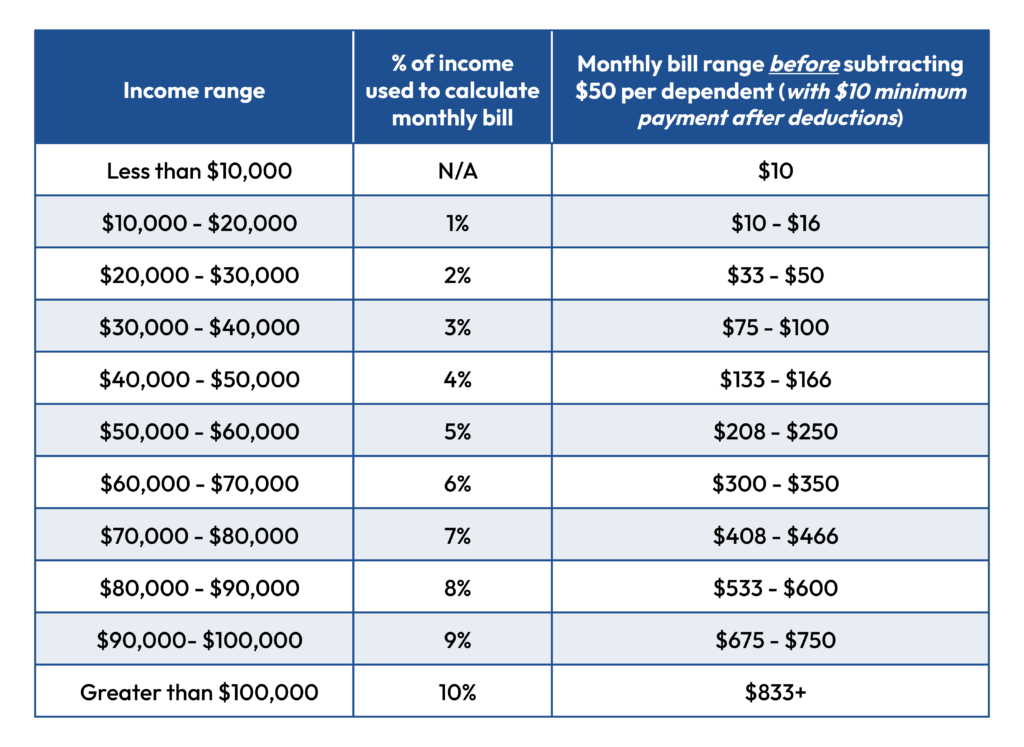
- Monthly payments are a percentage of your total income (between 1 and 10%, depending on your income level), with a $50 reduction for each dependent
- You must pay a minimum of $10 a month, no matter how low your income is
- All Direct Loans are eligible, except for Parent PLUS loans or any Consolidation loans that repaid a Parent PLUS loan
- FFEL loans are not eligible
- Any interest you are charged monthly that is not covered by your monthly payment will be waived
- You may receive an additional reduction of your principal of up to $50 if your monthly payment doesn’t reduce your principal by that much
- Cancellation after 30 years
- Qualifies for PSLF
- Time in RAP does not count towards forgiveness in IBR or other IDR plans (but time in other IDR plans counts toward forgiveness in RAP and in IBR)
More about RAP
PAYE
- Pay As You Earn (PAYE)
- This plan will be eliminated for all borrowers by July 1, 2028
- Payments set at 10% of income over 150% of the federal poverty level, with a cap of what you would pay in a standard plan when you entered repayment
- Only Direct Loans taken out by certain borrowers between 2007 and 2026 are eligible, and Parent PLUS loans and Consolidation loans that repaid Parent PLUS Loans are not eligible
- FFEL loans are not eligible
- PAYE will not be available to borrowers who have any loans issued or consolidated on or after July 1, 2026
- Cancellation after 20 years
- Qualifies for PSLF
ICR
- Income-Contingent Repayment (ICR)
- This plan will be eliminated by July 1, 2028
- Payments generally set at 20% of income over 100% of the federal poverty level, but capped using an alternative formula that may reduce payments
- Most Direct loans taken out before July 1, 2026 are eligible (Parent PLUS Loans are only eligible if they are consolidated into a Direct Consolidation Loan before July 1, 2026, and enrolled in ICR before July 1, 2028)
- FFEL loans are not eligible
- Cancellation after 25 years
- Qualifies for PSLF
SAVE
- The SAVE Plan is over
- Borrowers enrolled in the SAVE plan will be forced to pick a new plan sometime after July 1, 2026, and they will receive a notice from their servicer that they have 90 days to pick a new repayment plan.
- Click here for what borrowers need to know about the end of the SAVE plan
IBR: Income-Based Repayment
Which loans are eligible?
All FFEL Loans taken out for your own education are eligible for IBR.
All Direct Loans taken out for your own education before July 1, 2026 are eligible for IBR, unless you take out any new loans or consolidate loans on or after July 1, 2026.
Parent PLUS loans, taken out for your child’s education, are not eligible for IBR. However, if you consolidated Parent PLUS loans into a Consolidation Loan before July 1, 2026, and enroll them in ICR before July 1, 2028, then you can enroll in IBR after making at least one payment in ICR.
How much are payments?
Your monthly payment is based on your income and family size and depends on when you borrowed:
- Payments are 10% of your monthly “discretionary income” (the difference between your income and 150% of the poverty guideline for your family size) if you were a new student loan borrower on or after July 1, 2014.
- If you borrowed before July 1, 2014, payments are generally 15% of your monthly discretionary income.
In IBR payments are capped at what you would’ve paid in a fixed 10-year standard repayment plan when you entered repayment. However, if you hit the payment cap in the IBR plan, your interest will be capitalized (which means the balance is added to your loan’s principal, ultimately costing you more).
You must recertify (update) your income and family size each year, even if they haven’t changed.
If you’re married and you file your taxes jointly, you and your spouse’s combined income will be used to determine your payment. If your spouse also has federal student loans, then the amount of your payment will be reduced so it is proportional to your share of the total student debt owed by you and your spouse. If you file your taxes separately, only your income and student debt is used to determine your payment.
When will my loans be canceled under an IBR plan?
If you continue to make payments under IBR, any remaining balance on your loans should be canceled after:
- 20 years of payments if you were a new student loan borrower on or after July 1, 2014, or
- 25 years if you borrowed before July 1, 2014.
Payments in PAYE, SAVE, and ICR and in the 10-year standard plan count toward forgiveness in IBR, so if you switch plans to IBR, your time in prior plans will often count. Borrowers switching from IBR to RAP will keep the credit toward forgiveness they have earned in IBR, and it will count towards the 30-year forgiveness period in RAP. However, time spent in the RAP plan will not count towards IBR forgiveness.
Depending on your income and debt, you may pay off your loans before you reach 20 to 25 years of payments.
Is this plan right for me?
Of the IDR plans, only IBR and RAP will continue after July 1, 2028. IBR offers payments that may be the most affordable for some borrowers, especially low-income borrowers, high income borrowers, and many borrowers who are married. IBR offers payments as low as $0 for borrowers with income below 150% of the federal poverty level for their family size, and protection against payments ever exceeding what the borrower would owe in a 10-year fixed payment plan. It also offers forgiveness of any remaining balance after 20-25 years.
People who borrowed between 2007 and 2014 may be eligible for lower payments in PAYE than in IBR, but PAYE will be eliminated by July 1, 2028.
IBR is also the only income-driven repayment plan available to borrowers with FFEL loans.And after July 1, 2028, it will be the only income-driven repayment plan available to some borrowers with Parent PLUS loans. But those borrowers must have first consolidated their Parent PLUS loans before July 1, 2026, and enrolled in IDR before July 1, 2028.le to those who jumped through several hoops: parents must consolidate their Parent PLUS loans before July 1, 2026, and enroll in IDR before July 1, 2028, to be eligible for IBR.
RAP: Repayment Assistance Plan
Which loans are eligible?
RAP is a new plan available starting July 1, 2026.
All Direct Loans taken out for your own education are eligible for RAP. Additionally, if you take out a new Direct Loan or consolidate your loans on or after July 1, 2026, RAP will be the only IDR plan that you will be eligible to repay your Direct Loans in.
Not Eligible: Parent PLUS loans, taken out for your child’s education and any consolidation loans that repaid a Parent PLUS loan are not eligible. FFEL loans are also not eligible for RAP.
How much are payments?
Your monthly payment in RAP is based on your income and number of dependents.
Monthly payments are calculated as a percentage of your total annual income (using adjusted gross income, or AGI), divided by 12, minus $50 per month per dependent. Unlike other IDR plans, RAP does not allow $0 payments and requires a minimum payment of $10 per month. The percentage of your income that you will have to pay depends on the income range that you fall into each year, as shown below:
If you’re married and file taxes jointly, you and your spouse’s combined income will be used to calculate your payment, which can result in a significantly higher monthly payment. If your spouse also has federal student loans, then the amount of your payment will be reduced so it is proportional to your share of the total student debt owed by you and your spouse. If you file your taxes separately, only your income and student loans are used to determine your payment.
What benefits does RAP have that the other plans do not?
Your loan balance will always decrease while you’re in the RAP plan and making on-time payments because any interest that accrues during a month that is not paid off via your monthly payment will be waived. In addition, if your monthly payment does not reduce your principal by at least $50 on its own, the government will reduce your principal by up to $50 (though never by more than the amount of your monthly payment).
When will my loans be canceled under the RAP plan?
If you continue to make payments under RAP, any remaining balance on your loans should be canceled after 30 years of payments. Payments in other IDR plans, the 10-year Standard plan, and the Tiered Standard plan count toward forgiveness in RAP. So, if you switch plans to RAP, your time in prior plans will often count towards your 30 years.
The Department of Education predicts that most borrowers in RAP will repay their loans in full before 30 years, and so will spend less than 30 years in repayment.
Is this plan right for me?
If you take out a federal student loan or consolidate your existing loans on or after July 1, 2026, then RAP will be the only IDR plan available to you to repay your Direct Loans. If you want to pursue Public Service Loan Forgiveness (PSLF) or to make payments based on your income rather than the amount you borrowed, then RAP is your only choice.
If you borrowed all of your federal student loans before July 2026, then you may be deciding between RAP and IBR – the two IDR plans that will continue to be available even after PAYE and ICR are eliminated on July 1, 2028. Which plan is right for you will depend on your individual circumstances and goals.
In general, IBR offers a shorter time to loan forgiveness and offers lower monthly payments than RAP for many borrowers (especially borrowers who took out loans between July 2014 and June 2026, low-income borrowers, high-income borrowers, and many married borrowers and borrowers with kids). Payments in IBR may also become more affordable compared to payments in RAP over time because the IBR formula takes inflation into account and the RAP formula does not.
But other borrowers will have lower monthly payments in RAP, especially those who borrowed before 2014, are single, and have middle-incomes. Additionally, RAP offers more generous interest and principal subsidies that ensure that your loan balance actually goes down when you make on-time payments (which is not always true in IBR), and that can help you pay down your loans faster and potentially pay less in total over time.
PAYE: Pay As You Earn
PAYE is being eliminated: The PAYE plan will end by July 1, 2028. Any borrowers enrolled in this plan at that time will be transitioned to another plan (RAP or IBR). Borrowers who are currently on the PAYE plan can switch to a new plan now or wait for the plan to end. Follow NCLC and studentaid.gov for more updates.
Which loans are eligible?
Only Direct loans taken out for your own education are eligible for PAYE. Additionally, to be eligible for PAYE, you must have:
- received a Direct Loan on or after October 1, 2011; and
- had no outstanding Direct or FFEL loan balance when you received your first federal loan on or after Oct. 1, 2007; and
- not received any federal student loans or consolidated any federal student loans after July 1, 2026.
Not eligible: Parent PLUS loans, taken out for your child’s education, are not eligible for PAYE, and any consolidation loans that repaid a Parent PLUS loan are not eligible. FFEL loans are also not eligible for PAYE.
How much are payments?
Your monthly payment is based on your income and family size. Payments are 10% of your monthly “discretionary income” (the difference between your income and 150% of the poverty guideline for your family size), and are capped at what you would pay under the 10-year Standard repayment plan when you entered repayment.
You must recertify (update) your income and family size each year, even if they haven’t changed. If you’re married and file taxes jointly, both you and your spouse’s income and student loan debt will be considered to determine your payment. If you file your taxes separately, only your information is used to determine your payment.
When will my loans be canceled under a PAYE plan?
If you continue to make payments under PAYE, any remaining balance on your loans should be canceled after 20 years of payments. However, because the PAYE plan is being eliminated by July 1, 2028, and borrowers are only eligible for PAYE if they first borrowed after October 1, 2007, very few borrowers in PAYE will have reached 20 years of qualifying payments before the PAYE plan is eliminated.
Borrowers switching from PAYE to IBR or RAP will keep the credit toward forgiveness they have earned in PAYE, and it will count toward the 20-25 year forgiveness period in IBR and the 30-year forgiveness period in RAP. You may pay off your loans before reaching forgiveness, depending on your income and debt.
ICR: Income-Contingent Repayment
ICR is being eliminated: The ICR plan will end by July 1, 2028. Any borrowers enrolled in this plan at that time will be transitioned to another plan (RAP or IBR). Borrowers who are currently on the ICR plan can switch to a new plan now or wait for the plan to end. Follow NCLC and studentaid.gov for more updates.
Which loans are eligible?
All Direct Loans taken out for your own education before July 1, 2026 are eligible for ICR, unless you take out any new loans or consolidate loans on or after July 1, 2026. If you take out a new loan after July 1, 2026, you will not be eligible for ICR.
Not eligible: Parent PLUS loans, taken out for your child’s education, are not eligible for ICR. However, if you consolidated Parent PLUS loans into a Direct Consolidation Loan before July 1, 2026 then you can enroll them in ICR before July 1, 2028.
FFEL loans are also not eligible for ICR.
ICR was the only IDR plan available to borrowers with Parent PLUS loans – provided that they first consolidated their loans into a Direct Consolidation Loan. While ICR is being eliminated, Parent PLUS borrowers who act fast can enroll in IBR, which often offers more affordable payments than ICR. To enroll in IBR, Parent PLUS borrowers must have first consolidated their loans before July 1, 2026, and then enroll in an IDR plan (generally ICR) before July 1, 2028. They can then switch to the IBR plan, or will be transferred to the IBR plan on July 1, 2028. For more help, see our page on consolidating loans.
How much are payments?
Your monthly payment is based on your income and family size. Payments are generally set at 20% of your monthly “discretionary income” (defined for ICR as income over 100% of the poverty guideline). However, your payment may be lower based on a complicated alternative formula.
You must recertify (update) your income and family size each year, even if your situation hasn’t changed. If you’re married and file taxes jointly, both you and your spouse’s income and student loan debt will be considered to determine your payment. If you file your taxes separately, only your information is used to determine your payment.
When will my loans be canceled under an ICR plan?
If you continue to make payments under ICR, any remaining balance on your loans should be canceled after 25 years of payments.
Many borrowers will not have reached 25 years before ICR ends on July 1, 2028. Borrowers switching from ICR to IBR or RAP will keep the credit toward forgiveness they have earned in ICR, and it will count toward the 20-25 year forgiveness period in IBR and the 30-year forgiveness period in RAP. You may pay off your loans before reaching forgiveness, depending on your income and debt.
Is this plan right for me?
ICR is often the most expensive IDR plan, but not always, so it can be worth checking. Use the Repayment Calculator to estimate your payments in different plans. For a long time, ICR was the only plan available for borrowers with Parent PLUS loans that were consolidated into Direct Consolidation Loans. ICR will be eliminated for all borrowers by July 1, 2028.
